
Convert HTML to Word online using C# .NET
Seamless conversion from HTML to Word documents is a critical need. As businesses increasingly rely on diverse web‑based content, the demand for a method to transition this dynamic information into professionally formatted documents has become paramount. The HTML to Word Document (DOC, DOCX) conversion approach ensures consistency in corporate communication, detailed documentation, and streamlines document workflows for .NET developers.
HTML to Word Conversion REST API
Aspose.HTML Cloud SDK for .NET provides the capabilities to manipulate and convert HTML files to DOCX, XPS and other formats. Therefore, achieving HTML to Word conversion using this REST API is a seamless process that empowers you with dynamic and versatile capabilities. Its straightforward conversion process is complemented by the ability to tailor conversion options, ensuring control over page size, margins, and formatting. Beyond the core feature of HTML to Word conversion, the Aspose.HTML Cloud API for .NET offers a suite of functionalities, including HTML editing and conversion to various formats such as PDF and raster images.
To implement the document conversion routine in a .NET application, install the SDK from either NuGet or GitHub. Run the following command in the terminal window to install via NuGet.
nuget install Aspose.HTML-Cloud
Aspose.HTML Cloud APIs are secured and require authentication. Create a free subscription account on our cloud services via the Aspose.Cloud dashboard using a GitHub or Google account, or simply create a new Account and obtain your Client Credentials details.
Convert HTML to Word in C#
Follow the steps below to convert HTML to Word with C#.
- Firstly, create an HtmlApi instance while passing ClientID and ClientSecret details as arguments.
- Secondly, read the HTML from the local drive using File.OpenRead(..) method.
- Thirdly, create an instance of StorageApi and upload HTML to cloud storage using the UploadFile(…) method.
- Finally, call the PutConvertDocumentToDoc(…) method to convert HTML to Word and save the output in Cloud storage.
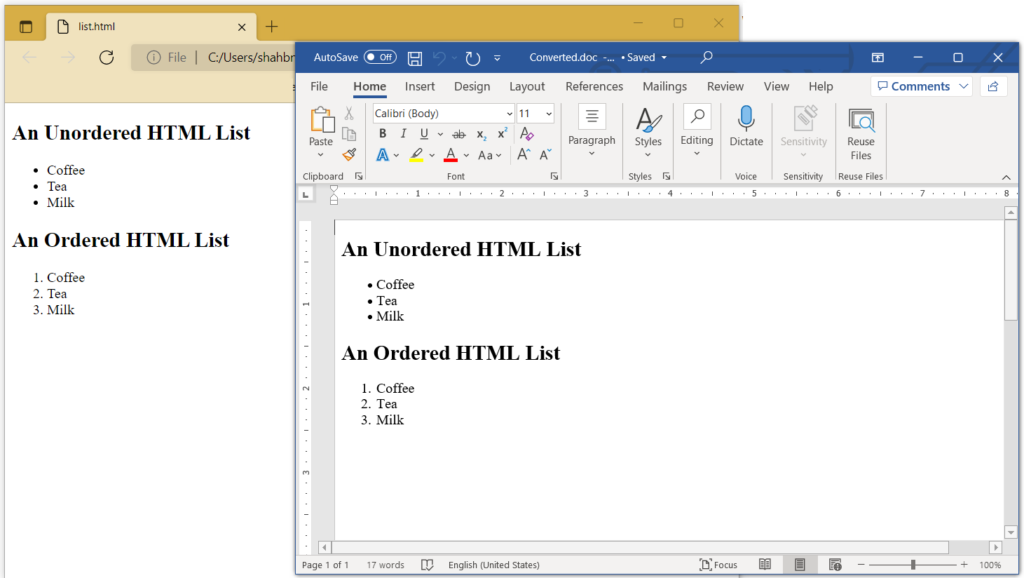
Image 1:- HTML to Doc preview
For your reference, the sample files used in the above example can be downloaded from list.html and converted.doc.
HTML to Word DOC using cURL Commands
Alternatively, using Aspose.HTML Cloud with cURL commands provides a flexible, scriptable solution. The cURL commands act as a bridge, seamlessly connecting your application to the powerful capabilities of Aspose.HTML Cloud. This method simplifies integration into diverse development workflows and ensures a consistent, reliable process for document generation and formatting.
Please follow the steps below to perform the HTML to Word conversion.
- Create JSON Web Access Token based on client credentials.
- Upload the input HTML to cloud storage.
- Call the GetConvertDocumentToDoc API.
- Save the output on the local drive.
curl -v "https://api.aspose.cloud/connect/token" \
-X POST \
-d "grant_type=client_credentials&client_id=bbf94a2c-6d7e-4020-b4d2-b9809741374e&client_secret=1c9379bb7d701c26cc87e741a29987bb" \
-H "Content-Type: application/x-www-form-urlencoded" \
-H "Accept: application/json"
Once the JWT is generated, execute the following command to upload the input HTML to cloud storage.
curl -X PUT "https://api.aspose.cloud/html/storage/file/inputHTML.html" \
-H  "accept: application/json" \
-H  "authorization: Bearer <JWT Token>" \
-H  "Content-Type: multipart/form-data" \
-d {"File":{}}
After the HTML is uploaded, use this command to convert it to a Word document and save the result locally.
curl -v -X GET "https://api.aspose.cloud/html/inputHTML.html/convert/doc" \
-H  "accept: multipart/form-data" \
-H  "authorization: Bearer <JWT Token>" \
-o Converted.doc
Conclusion
In conclusion, whether employing Aspose.Words Cloud API or Aspose.HTML Cloud API, you are equipped with powerful tools to seamlessly convert HTML to Word documents. Both approaches empower you to bridge the gap between dynamic web content and polished document creation, ensuring efficiency, accuracy, and consistency in diverse document processing workflows.
Useful Links
Related Articles
We also recommend visiting the following links to learn more about: