Java REST API for XML to JSON conversion.
XML (Extensible Markup Language) is widely used for structured data storage and exchange, while JSON has gained popularity due to its lightweight nature and ease of integration with modern applications. This conversion is particularly useful when transitioning legacy systems to newer architectures, integrating APIs, or ensuring efficient data exchange between platforms. By leveraging a Java REST API, you can automate this process, reducing manual effort and achieving faster, more accurate results.
- REST API to Transform XML to JSON
- Convert XML to JSON in Java
- Transform XML Schema to JSON Schema using cURL Commands
REST API to Transform XML to JSON
Aspose.Cells Cloud SDK for Java offers a powerful and efficient solution for converting XML to JSON, simplifying data transformation for modern applications. With just a few API calls, you can automate the conversion of structured XML data into the lightweight JSON format, enabling seamless integration with APIs, web applications, and mobile platforms.
Installation
To use the Cloud SDK, add the following Maven dependencies to your pom.xml file:
<repositories>
    <repository>
        <id>AsposeJavaAPI</id>
        <name>Aspose Java API</name>
        <url>https://repository.aspose.cloud/repo/</url>
    </repository>
</repositories>
<dependencies>
    <dependency>
        <groupId>com.aspose</groupId>
        <artifactId>aspose-cells-cloud</artifactId>
        <version>24.9</version>
    </dependency>
</dependencies>
- You can download the latest version from the Aspose Repository.
Then, obtain your client credentials from the cloud dashboard. If you do not have an account, create a free one by following the steps in the quick start guide.
Convert XML to JSON in Java
The following section explains how to transform XML to JSON using a Java code snippet:
CellsApi api = new CellsApi(clientId,clientSecret);
Create an instance of CellsApi with your client credentials.
api.uploadFile("input.xml", file, "basic");
Upload the input XML to cloud storage using the uploadFile(…) method.
File response = api.cellsWorkbookGetWorkbook(name,  password,format,
			isAutoFit, onlySaveTable, null,"basic",  "Resultant.json","basic", null);
Finally, call the method cellsWorkbookGetWorkbook(…) to start the conversion.
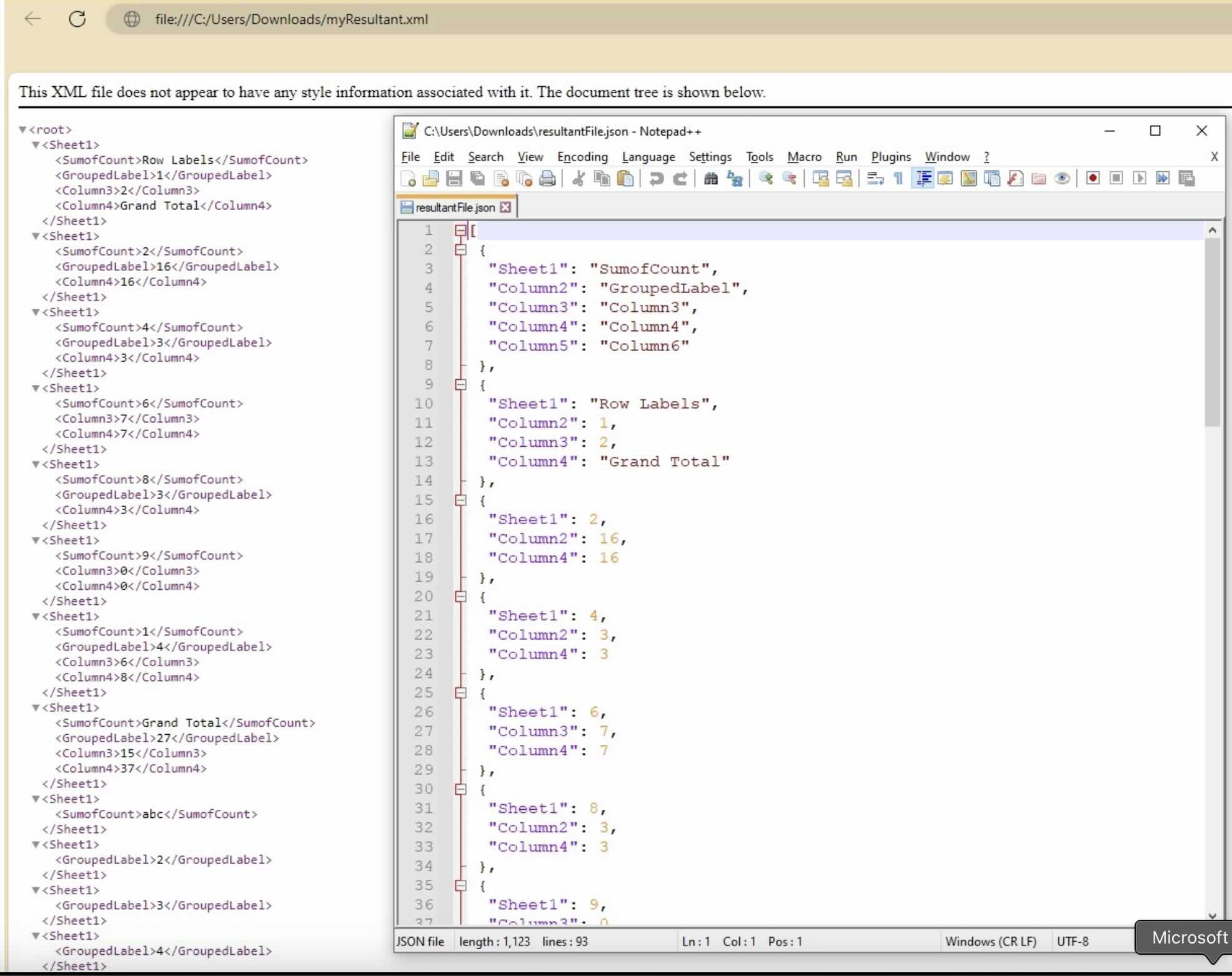
A preview of XML to JSON conversion.
Transform XML Schema to JSON Schema using cURL Commands
Converting XML to JSON with Aspose.Cells Cloud and cURL commands provides a quick, efficient way to handle data transformation in the cloud. With a few simple cURL requests, you can convert XML files into JSON format, streamlining integration between legacy systems and modern applications. Aspose.Cells Cloud offers a RESTful API that lets you upload your XML file, specify JSON as the output format, and download the converted file—all via straightforward cURL commands.
The first step is to generate a JWT access token:
curl -v "https://api.aspose.cloud/connect/token" \
 -X POST \
 -d "grant_type=client_credentials&client_id=XXXXXXX-b195-426c-85f7-XXXXXXXX&client_secret=XXXXXXXXXXXXXXXXXXXXXXXXX" \
 -H "Content-Type: application/x-www-form-urlencoded" \
 -H "Accept: application/json"
With the JWT token, run the following command to convert an XML file to JSON:
curl -v "https://api.aspose.cloud/v3.0/cells/{sourceFile}/SaveAs?newfilename={myResultant}&isAutoFitRows=false&isAutoFitColumns=false&checkExcelRestriction=false" \
-X POST \
-H "accept: application/json" \
-H "authorization: Bearer {accessToken}" \
-H "Content-Type: application/json" \
-d "{ \"SaveFormat\": \"json\",}"
Replace sourceFile with the name of the XML file stored in the cloud, myResultant with the desired JSON filename, and accessToken with the JWT token you generated.
To download the resulting JSON file to your local drive, use this cURL command:
curl -v "https://api.aspose.cloud/v3.0/cells/resultantFile.json?format=JSON&isAutoFit=false&onlySaveTable=false" \
-X GET \
-H "accept: application/json" \
-H "authorization: Bearer {accessToken}" \
-o "output.json"
Our Free XML to JSON Conversion App
Try our free XML to JSON Converter app. This lightweight, high‑performance app is built on Aspose.Cells Cloud and lets you experience the SDK’s capabilities instantly.
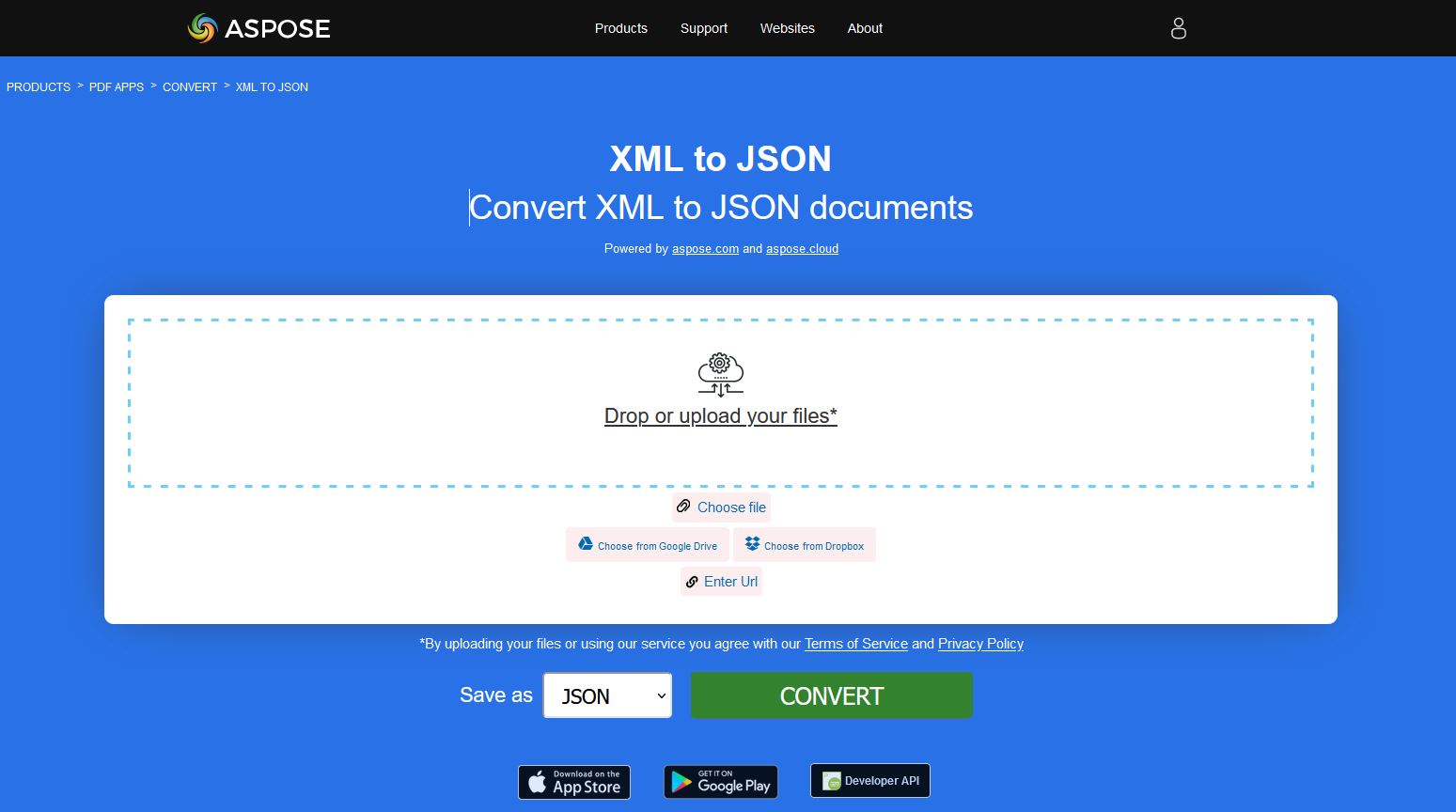
A preview of XML to JSON converter.
Conclusion
In conclusion, converting XML to JSON with Aspose.Cells Cloud and cURL commands delivers a fast, reliable, and scalable solution for modern data workflows. This approach simplifies complex data transformation, enabling seamless integration across platforms and applications. With Aspose.Cells Cloud’s powerful API, you can automate conversions, boost productivity, and ensure high‑quality results.
We encourage you to explore the Aspose.Cells Cloud SDK and experience its remarkable capabilities in transforming your data management processes.
Useful Links
Related Articles
Please visit the following links to learn more about: